
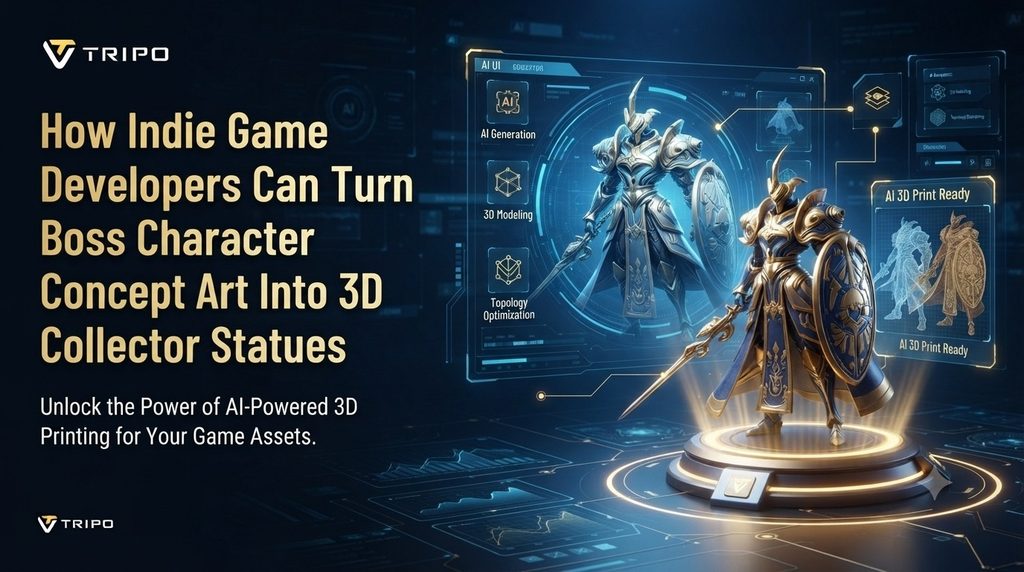

Each of the independent games has one iconic boss character. It could be a giant mechanical monster, a prehistoric beast that has never been seen before, or a villain from a dark fantasy—it might even be one of the quirky monsters that players will be discussing long after the game concludes. Such characters can emerge as the logo image of a video game and may be some of the most iconic aspects of the gaming experience.
Wouldn’t it be nice if those iconic boss designs were real? With the help of the modern image to 3D technology, now indie developers can produce concept art to create statues for fans to display on their desks and shelves. For developers, the creation of detailed 3D models from boss character images is now more accessible and speedy than ever, with the help of Tripo 3D, which allows them to create merchandise, reward loyal fans with merchandise, or build communities around their games.
On the final boss leaving the screen
Boss characters are supposed to make an impact. They can contain the most intricate art, special skills, and the most interesting encounters in a game. Players are able to remember these characters as key stages in the game journey. When a superior boss is defeated, it’s a rewarding experience and many fans will form strong bonds with these memorable moments.
They can turn the concepts into real statues, allowing developers to bring those experiences to life outside of the computer. With Tripo 3D, it’s possible to realise digital creations into physical form without losing the visual identity that players enjoy.
The idea behind collector statues for indie games
Now it’s not just big gaming halls where merchandise is available. Brands are increasingly turning to collectibles to help build brand loyalty and cash in on new revenue streams, from independent developers.
Providing fans with a sense of ownership
Players can own a piece of the game that they enjoyed by owning collector statues. These physical goods establish deeper psychological links amongst fans and the game’s world.
Creating premium rewards
Special edition statues can be added to crowdfunding campaigns, deluxe game bundles and community reward programs, providing additional value to those who really like the game.
Expanding brand visibility
Statues on the fan’s home or in their social media feeds are advertising the game for free, getting it played by new fans.
Creating concepts into product possibilities
A lot of indie developers already spend a lot of time making a detailed boss character art. They are often used in promotional materials, game trailers and social media promotions and in art books.
Developers can not only leverage them digitally, but also create collectible products from the assets. Tripo 3D lets teams bring concept art to life into high-quality 3D models, without having to manually model for hours. This creates new opportunities to monetize and to get the best possible value of the assets that already exist.
From sketchbook nightmares to shelf-worthy legends in 3D with Tripo 3D
Making a collectible boss concept art statue is simpler than one might think. Tripo 3D is a streamlined process that can help bring characters to life rapidly.
Step 1: Select Tripo 3D
First, enter the Tripo AI Workspace, select how you want to create— image-to-3D or text-to-3D, or multiple views of the same character.
Step 2: Insert reference image and configure settings
Upload images (in JPG, PNG, or WEBP formats) of your boss character to start processing to 3D. Next, set generation parameters as needed for the project, such as the level of mesh quality (ultra versus smart mesh) and texture size. Generating using higher-quality options aids in the protection of unique character features and complex design details.
Step 3: Generate and refine
Use the generate button to create an initial model in seconds. Also, use the refiners that process textures, take out components, and use magic brushes to modify and refine visually.
Step 4: Export
When the model is finished, export it in your desired format. Tripo is compatible with STL, OBJ, FBX, GLB, and USD, allowing you to seamlessly develop for manufacturing, animation, game integration, or 3D printing.
Elevating and making memorable villains
In some iterations of the game, some boss characters may have elaborate armor or may have complicated silhouette designs, weapons, or creature designs. These elements are definite aspects that help shape their personalities and influences.
Physical statues offer fans a way to enjoy these elements that sometimes can’t be captured in a screenshot or concept art. A good collectible piece tells about the crafting of the character and gives a different angle to the design. Through 3D Modeling Web, the developers can easily convert illustrations into detailed 3D models, saving time and enabling them to focus on creative refinement.
Expansion of the game universe: more than collectibles
After a boss character has been created as a 3D asset, it can be used for many more purposes than statue production.
The developer can utilize the model in promotional videos, in animation, social media campaigns, augmented reality experiences, and digital marketing materials. Tripo 3D enables the production of diverse assets that can be utilized for both development and promotional purposes. The flexibility gives studios the ability to get the best return on their creative investment and to have a uniform look across all media platforms.
From digital villian to tangible art
Collector statues are rarely created on a large scale before the developers have made a prototype and tested out aspects, proportions, and presentation. Physical prototypes are used to identify opportunities for improvement and to make sure that the final product is what the artist wanted. They also serve as great resources to use for marketing campaigns, crowdfunding pages, and convention displays.
Many creators use an image to STL workflow to prepare boss character models for their production. This streamlines the development of moving from concept art to actual collectibles, maintaining the distinctive aspects that make every boss special.
Creating more resilient communities via collectibles
It’s not about money; it’s about people. Many fans who fall in love with a game’s world, like the one in World of Warcraft, want to be able to show their appreciation for the game and the world beyond playing.
There is nothing better than celebrating favorite characters with Collector statues and connecting them with developers and players alike. Exclusive versions, signed releases, and limited edition versions can also help build community excitement and engagement. Indie developers can use Tripo 3D to convert their boss character concept art into 3D models that can be used for merchandise, promotional campaigns, and fan engagement programs. Whether it’s iconic villains, terrifying monsters, or epic boss battles, any iconic boss can be immortalized as a collectible gaming memory.
Looking to transform your ideas for a boss character design into a collectible figure? With Tripo 3D, you’ll be able to see how easy it is to create your very own high-quality 3D models.