
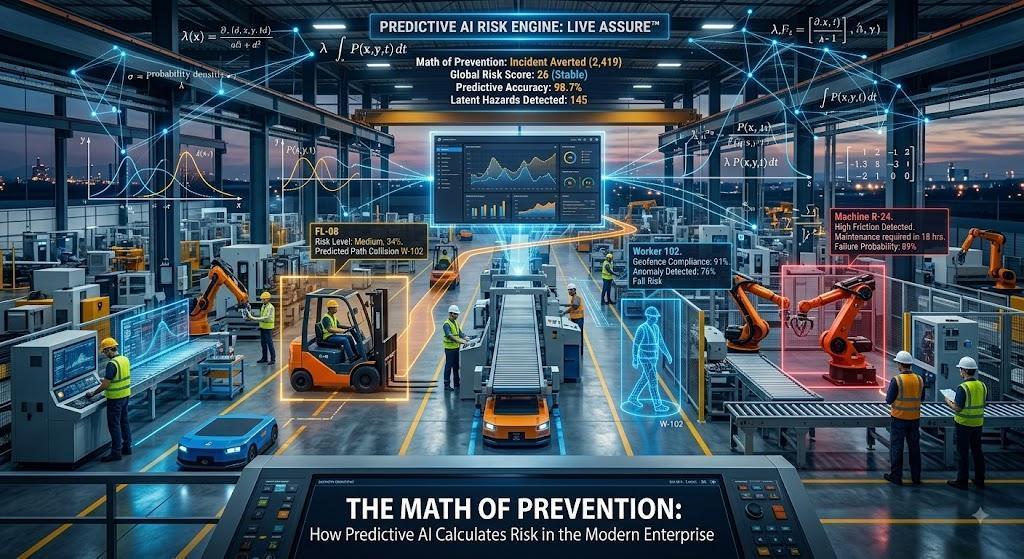

The Forensic Hangover
For a century, occupational safety has operated as a glorified autopsy. Enterprises relied heavily on lagging indicators to understand their operational vulnerabilities. We are talking about recordable injury rates, lost-time incidents, and messy post-accident investigations. The reality is that by the time you collect and synthesize this data into a sterile PowerPoint, the physical and financial damage is already done. Dead bodies. Mangled steel. A guy named Herbert Heinrich actually cracked this math way back in the 1930s. He dug through piles of insurance claims to establish one undeniable truth. Major catastrophes never just happen; they follow hundreds of ignored, silent warnings. Human friction makes tracking those micro-events completely impossible. Workers actively ignore minor hazards or fear punitive retaliation for reporting them. Today's massive industrial footprint requires something much sharper than a retrospective clipboard and subjective human audits. High-performance edge computing and ubiquitous CCTV infrastructure have recently collided. They are dragging risk management out of the forensic dark ages. AI platforms now process thousands of visual data points per second to expose those hidden leading indicators. We are effectively watching the mathematical foundation of enterprise risk change in real-time.
Algorithmic Geometry (and Why Your Warehouse is a Casino)
To actually grasp how these predictive safety engines work, you have to look at the sheer scale of the probabilistic datasets involved. The underlying logic mirrors the exact mathematical systems governing digital gaming and actuarial models. When normal people play the lottery online, they interact with backend architectures that continuously calculate massive permutations and define strict statistical odds across millions of simultaneous events. Machine learning risk assessments execute this exact same mathematical premise. Except, they apply it to the physical coordinates of a steel plant or a logistics hub. An AI evaluates millions of pixels to weigh independent and dependent variables; it tracks the velocity of a forklift alongside the erratic trajectory of a tired pedestrian. The algorithm then aggregates these distinct factors into a continuous probability distribution. It calculates the exact statistical likelihood of a collision before the metal ever touches the flesh. Pure math. You are no longer guessing about environmental hazards based on outdated spreadsheets.
Beating the Physics of Latency
Let's be real about the hardware constraints here. A modern manufacturing facility easily operates hundreds of high-definition IP cameras simultaneously. You cannot just transmit those continuous 4K video streams to a centralized cloud server for real-time processing. Bandwidth limitations and data egress costs will bankrupt you. Network latency is the actual killer. A cloud delay of two seconds is the literal difference between a successful automated intervention and a fatal accident involving a reversing multi-ton excavator. Two seconds. That is an eternity. Companies solve this physics problem by leaning hard into hybrid edge-to-cloud architectures. The heavy neural network inference runs locally on embedded GPUs—like the NVIDIA Jetson AGX Orin—right there on the factory floor. Engineers solve this by brutally compressing the models. Neural networks usually chew on fat 32-bit floating-point numbers, but edge optimizers crush that math down to 8-bit integers. Latency crashes from a sluggish 44 milliseconds per frame to an almost instantaneous 6.1 milliseconds.
The Kalman Filter and the Math of Not Getting Crushed
A single static frame of a forklift is basically useless if you do not know where the machine is heading next. Temporal understanding requires Multi-Object Tracking algorithms, and DeepSORT is currently running the industry. This system links discrete bounding boxes across sequential video frames to plot a continuous historical and future trajectory. The actual mathematical engine keeping workers alive here is the Kalman Filter. This recursive algorithm estimates the true state of a dynamic system out of highly noisy measurements. It operates in a relentless predict-and-update cycle. The math maps an eight-dimensional vector that includes center coordinates, aspect ratio, height, and their respective velocities. The AI continuously projects these state vectors forward in physical space. If the projected math shows an autonomous loader intersecting with a human pedestrian within a critical time threshold, the system triggers a localized hardware halt instantly. Dead stop. Environmental challenges make this incredibly difficult; legacy industrial cameras often shoot in grainy grayscale, and high visual clutter causes tracking models to constantly drop IDs. DeepSORT mitigates this by integrating deep learning appearance descriptors to re-identify workers mathematically after they step behind a piece of machinery.
Unsupervised Paranoia and the "Cry-Wolf" Crisis
Standard object detection models have a massive blind spot. They only find what you explicitly trained them to see. To catch zero-day hazards—a pressurized pipe bursting or an erratic chemical spill—advanced platforms use Spatio-Temporal Autoencoders. The network trains strictly on normal operational footage. It compresses spatial features and temporal dynamics into a dense latent representation. When a worker randomly collapses, the system completely fails to reconstruct the anomaly from its "normal" data banks. It instantly calculates a massive reconstruction loss spike. Threat detected.
The catch? This relentless algorithmic vigilance creates a severe operational nightmare. Your safety team will tune out that dashboard noise in about a week. False positives breed a toxic culture of apathy. Nobody checks the feed when the system screams wolf thousands of times a day. Smart architectures kill this fatigue by stacking contextual filters over the raw video. The software cross-references physical proximity with actual IoT energy draws before a human ever sees a push notification.
1,600 Degrees and the True Cost of Doing Business
Theoretical software frameworks shatter when you drop them into a functioning steel mill. A steel mill is basically a hostile environment by design. You have temperatures hitting 1,600°C, airborne toxins, and gigantic machines moving around fragile humans. Places like Tata Steel and POSCO stopped messing around with clipboards and wired up their blast furnaces with continuous AI tracking. These systems actively enforce crane geofences and monitor worker posture in real-time. The financial math here is brutal and unforgiving. A single severe injury easily costs an enterprise upwards of $1.5 million in direct medical payouts, complex litigation, and lost productivity. Federal regulators are not playing games anymore. OSHA penalties just topped $165,000 per violation, making the upfront cost of an AI deployment look like a rounding error. You might drop half a million dollars wiring up a major facility. But when you factor in dodged fines, automated compliance, and instant insurance premium cuts, the finance guys usually see a total payback in under a year. Massive returns.
The Panoptic Threat
We have to address the elephant in the room regarding constant algorithmic observation. Nobody likes a machine staring at them all day. Mounting an unblinking, mathematically perfect camera network above a unionized workforce creates immediate, hostile paranoia. The academics label this the panoptic effect, but on the floor, it just looks like a total collapse of basic trust. Unions correctly point out that safety cameras can easily be weaponized by management for punitive productivity tracking. Smart enterprise platforms avoid this ethical minefield through strict privacy-preserving architectures. The AI explicitly does not use facial recognition. It assigns a temporary, anonymous bounding box to a human shape, calculates the trajectory risk, and then instantly dumps the raw video feed. Gone forever. Only the mathematical metadata goes to the cloud. Tomorrow's industrial winners will not just be the companies with the fastest inference times or the best anomaly detection rates. The real advantage belongs to organizations that figure out how to mathematically eliminate physical risk without treating their own workforce like suspects in a lineup.